Middle Game
End Game
Game Collections
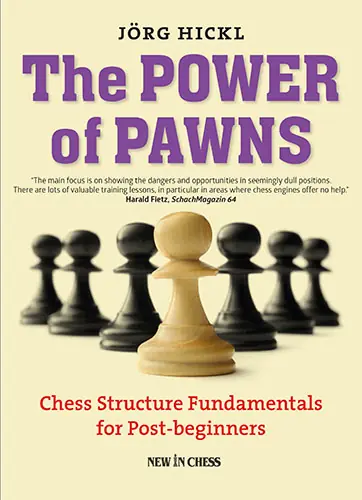
The Power of Pawns
Manpreeth Singh
Founder Ocean Chess
PUBLISHED ON
Dec 28, 2025
Print Length
192
Language
English
Publisher
New in Chess
Publication Date
2019
A few heuristics about pawns guide my play: put your pawns in the center, avoid doubling your pawns, avoid backward pawns, attack the center when attacked in the flank, attack the flank when attacked in the center, and of course if you have a passed pawn, push it! I hoped The Power of Pawns would expand on those ideas in a clear, structured way. Instead, the instruction on pawns is implicit and not systematic. The author illustrates broad themes through high level games, which he only sparsely annotates. The games covered in each chapter are unified by a theme, but mostly you have to work that out for yourself because Hickl appears to assume it’s so obvious that he doesn’t need to comment most of the time. Overall, Hickl presents the reader with full games where pawn structures play a critical role, but he doesn’t always spell out the key lessons or distill general principles.
Introduction
“Play well with the pawns,” Philidor famously said, “They are the soul of chess.” There are a few heuristics about pawns that guided my play: put your pawns in the center, avoid doubling your pawns, avoid backward pawns, attack the center when attacked in the flank, attack the flank when attacked in the center, and of course if you have a passed pawn, push it! And yet while I felt I had a solid grasp of maximizing the activity of my pieces, playing well with pawns remained a mystery. A quick search revealed that Chess Structures: a Grandmaster’s guide, was universally agreed upon as the best book on pawn play, but also not an easy read. I picked up The Power of Pawns instead when I heard Neil Bruce call it the best primer for chess structures on the Perpetual chess podcast. Neil Bruce has a peak rating of over 1800 USCF while mine is just over 1700 lichess. This is a massive difference that will inform why maybe I did not find this book as clear and useful as Neil Bruce did.
This beautiful position was played between Leonhardt and Burn in 1911. It’s white to play, but the evaluation wouldn’t change much if it were black’s turn. Who is better and why?
Chessmind is a great learning platform where you can answer positional questions and get instant feedback. It recreates lesson conditions, and comes close to having a chess coach! Try it out!